
          PI DAY (March 14), 2012

        3.14159265358979323846264338327950
     2884197169399375105820974944592307816
   406286       208        998
 62803          482       534
 211           706        798
              214        8086
             5132        8230
            6647         0938
           4460         95505
          82231         72535
         94081          28481
       117450           284102
      7019385            211055
      596446             229489+
|
In an evolving and complex world, we will excel as the Nation’s expeditionary “force of choice.”
— General James T. Conway, 34th Commandant of the Marine Corps Marine Corps Vision and Strategy 2025
Our Motto
Semper Fidelis means Marines are “Always Faithful” to the country, the Marine Corps and each other. Our nation entrusts us with its young men and women and we respond with an unbreakable commitment, in combat and in life.
Capabilities
The Marine Corps has been America’s expeditionary force in readiness since 1775. We are forward deployed to respond swiftly and aggressively in times of crisis. We are soldiers of the sea, providing forces and detachments to naval ships and shore operations. We are global leaders, developing expeditionary doctrine and innovation that set the example, and leading other countries’ forces and agencies in multinational military operations.
These unique capabilities make us “First to Fight,” and our nation’s first line of defense.
Fighting Philosophy
Every Marine is a rifleman, trained first as a disciplined warrior regardless of occupational specialty. This training is key to our philosophy of maneuver warfare. Maneuver warfare combines strategic positioning with firepower, demands agile forces capable of quick decision making, and employs the human elements of war — boldness, creativity, intelligence and the warrior spirit.
Our combined arms approach compounds Marine Corps strength by bringing our land, air and sea forces together to achieve every mission. This organization creates a scalable force with incomparable war-fighting capabilities. It is the key to winning battles.
Here is a blast from the past. I published this around the time Mena and Ben were getting massive user adoption with Movable Type. I think one of Mena's guys or experts actually installed this LAMP stack on my server back in 2005. It's still running on an incredibly old version and has never gone down - other than when Verio moved my blades.
Sam


I need one of these - you know, for all those urban off road adventures where I frequently encounter wild animals that need a little nudge... it's actually an ARB design and build offered through Toyota in Australia as original equipment.

The Web 2.0 - It's not about the hype or about the next big thing in the Internet. It's about the fundamental shift in the way applications are developed, packaged, licensed, marketed, disseminated, supported, and consumed. It's about software as a service. It's also about the excitement these small startups have and the direction they are taking applications and the Net.
Imagine a world where you are always connected to the Net. A world where you can rid yourself of your 7 pound laptop its heavy hard drive and all the software and applications installed on it. Imagine not having to ensure you have the latest version of your office productivity suite, web browser, CRM app, etc. This imaginary world is closer to reality than we think and these tiny startups are providing the code and tools to get us there quickly.
Look at Windows Live and Google Personalized. Look at the browser-based word processing startup (writely) that Google just acquired. Before we know it, we will be able to access all of our content (structured and unstructured data) and services (applications) remotely from the Web. We will be able to carry out this interaction from any device, anywhere in the world, and we will be able to interact with the network regardless of who we are or our relationship with the Net and other constituents on the Net.
Take Sun's Sun Ray Server Software thin client concept to the Net and allow the Net to be the server and allow access from any device with connectivity to the Net.
The only remaining service left to be figured out is our identity. That is, an open, utility-based, hosted, and online clearinghouse that controls the authorization and authentication of our content and services. Simply, who we are, what we have access to, and the credentials we need to "trust" that what we are accessing is ours and that we control who has access to our content and services.

Edward Tufte has written seven books, including Visual Explanations, Envisioning Information, The Visual Display of Quantitative Information, and Data Analysis for Politics and Policy. He writes, designs, and self-publishes his books on analytical design, which have received more than 40 awards for content and design. He is Professor Emeritus at Yale University, where he taught courses in statistical evidence, information design, and interface design. His current work includes landscape sculpture, printmaking, video and a new book.
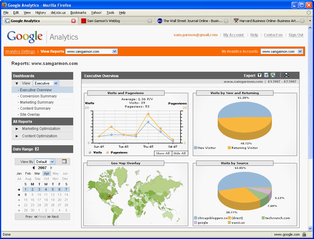
I have been using Google Analytics since it was in Alpha/Beta and I have to say it is a really awesome FREE web analytics tool. I just wish they would give you some sort of RSS option so that I can get "reporting" via my reader. I'm really not into that whole going to many places to get my information... ;-) - I prefer the one stop shop/view feature that readers afford.
I have also been using Google Apps for your Domain but since I get my domain's POP email through Gmail (you don't have to change your domain MX records) I really don't need it - since it is just my wife and I that use email on my domain.

This is the best presentation I have ever seen. Dick Hardt delivers a compelling and dynamic introduction on Identity 2.0 and how the concept of digital identity is evolving.
We are experiencing a shift in technology and business enablers. Businesses are applying tighter financial checkpoints and making smarter technology decisions in all areas of information technology. Businesses are looking to technology to do nothing other than enable corporate strategy.
We are seeing a convergence of Portal, Dashboard, CM, DM, BI, Web App Dev, and KM. KM not as a discipline, but rather, as integral components of the portal (i.e. weblogs, wikis, collaboration, RSS Feeds, threaded email discussions, instant messaging, expert locators, social networks, communities, search, taxonomy, etc.). We also know that our customers are seeing this convergence as well. We are actually delivering it to them in many instances. The vendors are certainly seeing it with the recent mergers and acquisitions that have occurred. And the analysts are seeing it. We also know that the Portal (in some form or another) will be the desktop. We know that the ultimate end game is control of the desktop. The Portal. It will be an interesting race to see who is prepared to be first to market with this offering and with this message. That is, the message of convergence.
This shift in technology and business enablers I spoke about earlier is nothing less than a paradigm shift. Let’s make sure we are not only first to market with this message, but also, best to market. Best to market implies smarter and faster than our competition. It means crafting the message to the market and educating our sales staff affording us the opportunity to implement and deliver upon this paradigm shift.